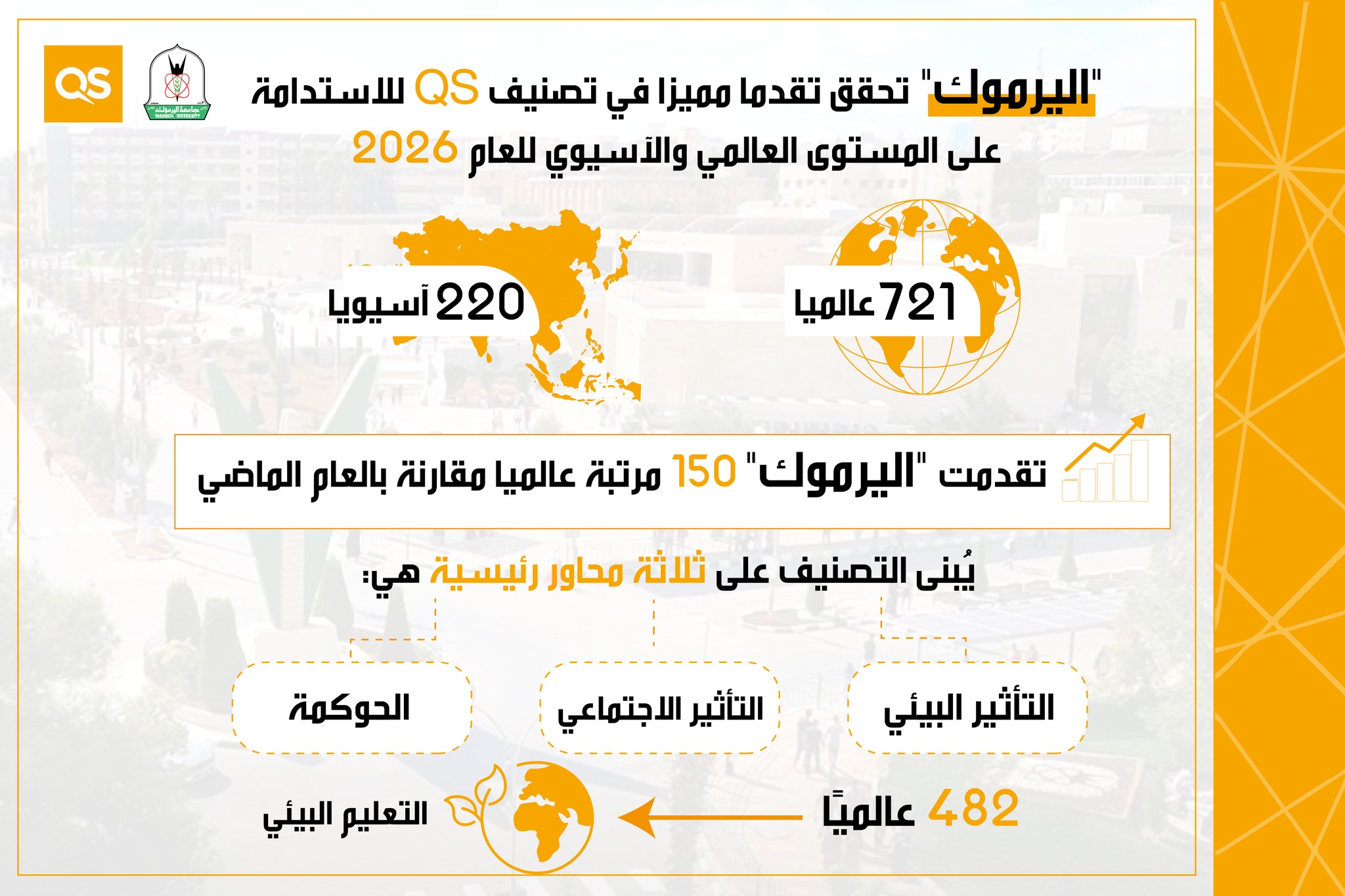
Yarmouk University has made remarkable progress in the QS Sustainability Rankings 2026, reaching the 721st position globally out of 2002 participating universities worldwide.
On the level of universities in the Asian continent, Yarmouk University secured the 220th rank among 827 participating universities, advancing approximately 150 ranks globally compared to its achievement last year. This confirms the university's serious commitment to achieving the Sustainable Development Goals.
This important ranking is built upon three main pillars: Environmental Impact, Social Impact, and Governance. The university recorded outstanding performance in the "Environmental Education" metric, achieving the 482nd rank globally, which reflects the depth of its academic presence in environmental fields and its growing role in supporting sustainability through education and research. It also occupied advanced positions in the other two pillars.
The President of the University, Prof. Malek A. Alsharairi stated that this advancement is the result of a clear strategic vision that the university has pursued towards building a sustainable institutional legacy since its inception in 1976. He explained that the university was founded with a developmental vision aimed at serving the community, and today it translates this vision by integrating sustainability concepts into university policies, academic programs, and research activities. Also, He praised the efforts of all academic and administrative staff who contributed to achieving this milestone.
In the same context, The Vice President of the University, Prof. Ruba Al Bataineh, affirmed that the university's vision is not limited to improving its position in international rankings, but goes beyond that to affirm its role as an active partner in achieving the Sustainable Development Goals locally and globally. She stressed that this progress proves that sustainability at Yarmouk University is not just a slogan, but an integrated institutional path adopted by the university and translated into tangible policies and practices.
For his part, The Director of the Accreditation and Quality Assurance Center, Dr. Ali Shehadeh, confirmed that this advancement reflects the integration of efforts across the university. He commended the role of the Rankings Section within the center and its Sustainability Office in monitoring performance indicators, preparing reports, and coordinating institutional work within the ranking pillars. He emphasized that this achievement reflects the importance of systematic joint work in enhancing the university's presence on the global higher education map in the field of sustainability.